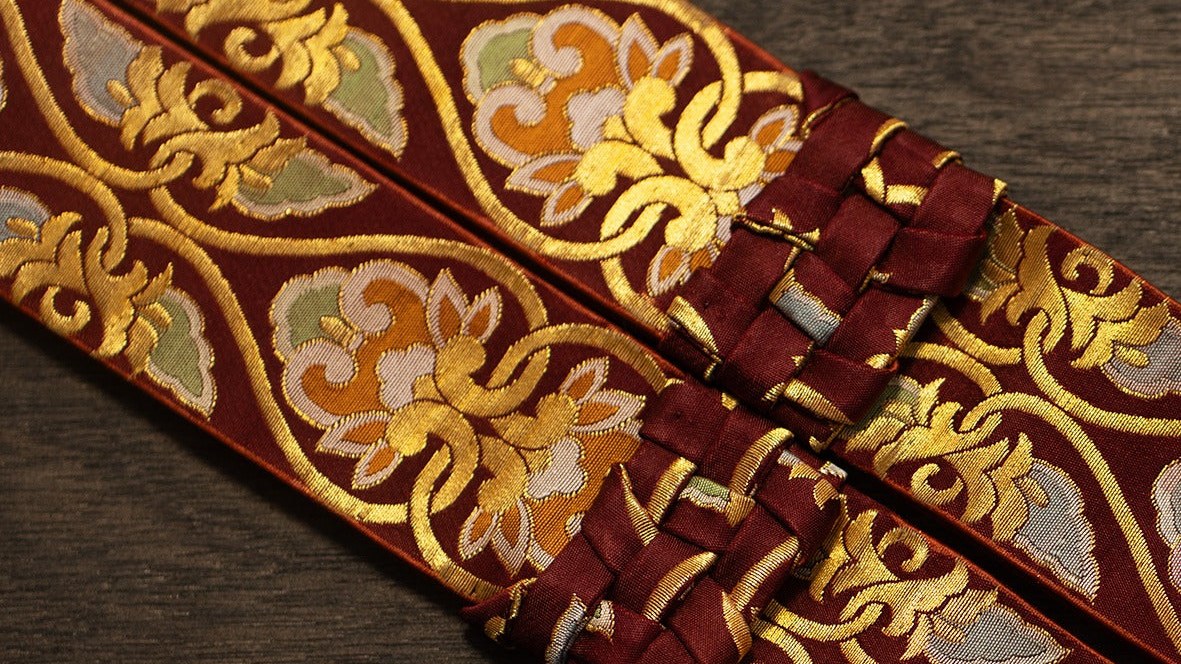
Repairing the Jabara of a Tatami-gesa: How Reinforcement and Fabric Replacement Differ
When the inner Jabara of a Tatami-gesa is torn, there is more than one way to repair it. One is to reinforce it by applying fabric; the other is to remove the Jabara and replace it.
Which to choose depends not only on the extent of the tear but also on the condition of the surrounding fabric and on how you wish to use the piece from now on. Here we explain the difference, with photographs of a Tatami-gesa whose Jabara was remade in new fabric.

What We Checked on the Tatami-gesa in the Photographs
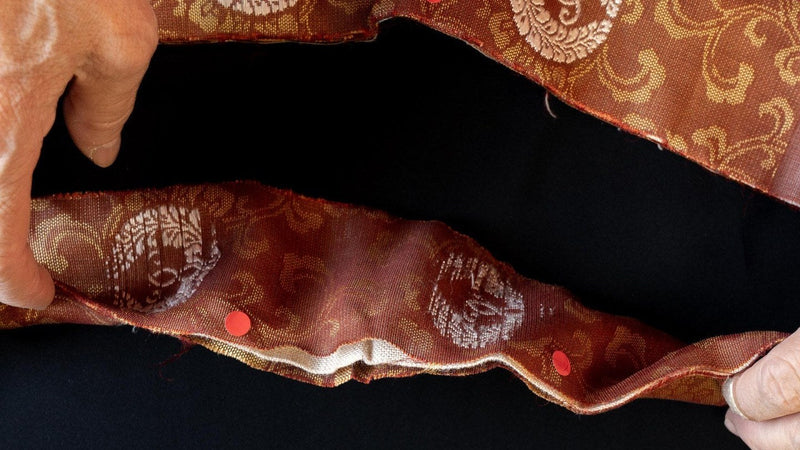
The Tatami-gesa in the photographs not only had holes in the Jabara on the inside; its outer fabric was also worn from rubbing. Even within a single piece, the suitable repair differs with the location and extent of the damage.

Method 1: Reinforcing with Applied Fabric
In this method, fabric is applied to the damaged Jabara to reinforce it, so that the piece can continue in use. At Naoshichi, rather than applying a small patch only to the torn area, we reinforce the Jabara by applying a longer piece of fabric across the area as a whole.
The original Jabara is left as it is. The extent of the work differs from Method 2, in which the Jabara fabric itself is renewed. When the fabric on the outer side or at the edges has also weakened, damage may appear in another place after the reinforcement. We consider the repair after checking the condition of the surrounding areas as well.
Method 2: Replacing the Jabara Fabric
In this method, the original Jabara is removed from the Tatami-gesa and remade in new fabric. It is not only a change of material; the steps of unpicking and reattaching are also needed.
This is an option when you wish to go on using the piece with care, as with one handed down from a predecessor or one received as a gift. However, when the fabric on the outer side or at the edges has also weakened, replacing the Jabara alone is not always enough.

For a detailed look at this Tatami-gesa before and after repair, see our article on remaking the Jabara and re-tailoring the outer fabric.
Three Things to Check Before Choosing
-
How far the damage extends
We also check around the holes, the seams, the edges and the points where the cords are attached.
-
How the piece will be used from now on
We ask what you would like: to go on wearing it, to use it for particular services, to preserve it in its original form, and so on.
-
Whether the cost and the work involved are appropriate
Reinforcement with applied fabric and replacement of the fabric differ in materials and in the work involved. The scope, including washing and any other repairs, is confirmed in the estimate.
Consult Us Even While You Are Still Deciding Whether to Repair
Please also tell us what you have in mind, for example "I would like it repaired while it is being washed," "It means a great deal to me and I want to keep it," or "I am unsure whether to have a new one made instead." Naoshichi acts as the point of contact, considers the method that suits the condition of the piece, and proceeds with the work once we have your consent.
The cost varies with the state of the damage and the repairs involved. Approximate figures for each type of item are set out in our table of approximate repair prices. We prepare the estimate after examining the piece itself. When areas other than the Jabara are also damaged and the whole piece is repaired, the cost can be higher than having a new one made. In that case, we provide estimates for both repair and a new piece.
More on repair and lining replacement / Care for an inherited Kesa / Complete guide to care
Send photos and ask about repairWe accept orders from outside Japan.
Ordering from outside Japan | Contact us (we reply in English)